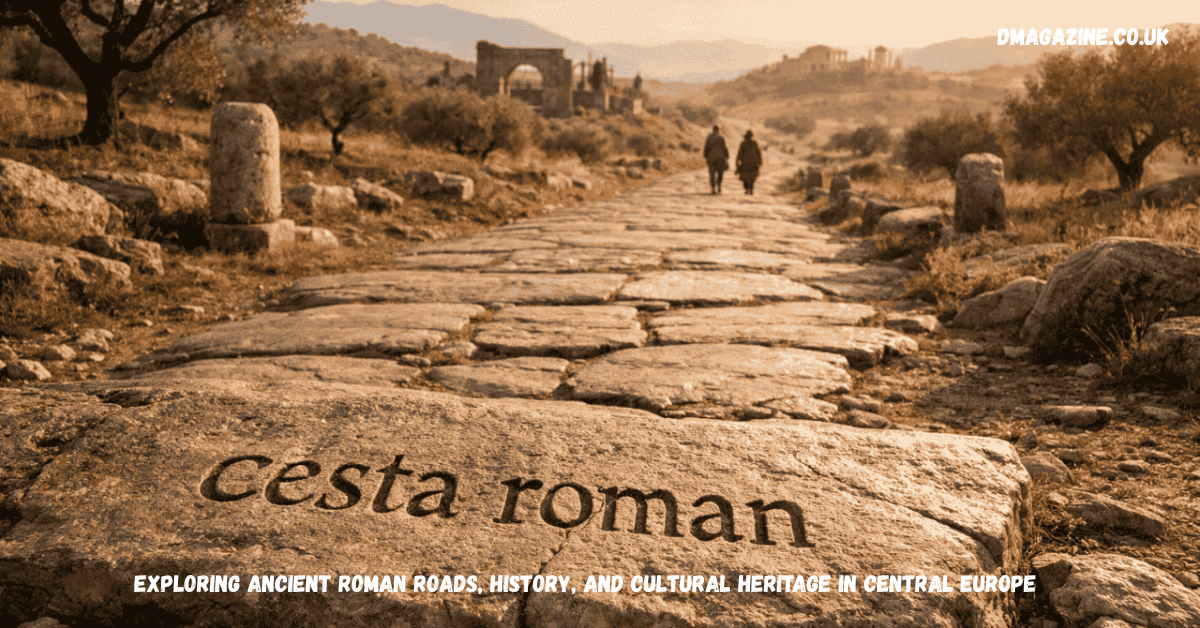
Imagine walking along an ancient stone path, where every ridge, rut, and worn stone carries echoes of soldiers, merchants, and travelers from over two millennia ago. This is the experience of the Cesta Roman — the ancient Roman roads that once formed the backbone of one of history’s greatest empires. These roads were far more than transportation routes; they were lifelines of the Roman world, enabling trade, military movement, cultural exchange, and administrative control across continents. Their remarkable design and enduring legacy still captivate historians, engineers, heritage travelers, and adventurers today.
In this comprehensive guide, we’ll journey through the technical genius of Roman engineering, explore the history and cultural impact of these routes, and highlight the best ways to experience Cesta Roman remnants in Central Europe, especially in Slovenia and Croatia.
What Does “Cesta Roman” Mean?
Slavic Interpretation: Roman Roads Across Central Europe
In many Slavic languages — particularly Slovenian and Croatian — the word cesta simply means road. Hence, Cesta Roman or Rimska Cesta refers specifically to the ancient Roman roads that once traversed the landscapes of this region. These routes connected distant provincial communities with the broader Roman Empire, fostering economic, military, and cultural ties that endured for centuries.
Roman roads in Central Europe still leave visible impressions in places like the Logatec trail in Slovenia, where deep grooves carved into limestone tell the story of countless carts and wagons that passed this way. Today, these paths are cherished archaeological and heritage sites.
Latin Connection: Basket (Cista) Symbolism and Cultural Roots
Interestingly, in Latin, the word cista refers to a woven basket used in everyday life for carrying goods or agricultural produce. While not directly linked to road construction, this meaning poetically underscores the human element of ancient travel — people carrying commodities and culture along structured paths that tied regions together.
A Brief History of Roman Roads
Roman roads were not an afterthought; they were a strategic priority from the early days of the Roman Republic. The construction of paved roads began as early as 312 BCE with the Via Appia (Appian Way), the first major long-distance Roman road. Initially stretching from Rome to Capua, it was later extended to Brindisi in southern Italy.
Over centuries, Roman engineers built a road network that spanned the Mediterranean and beyond. At its peak, this system is estimated to have encompassed more than 400,000 kilometers (about 250,000 miles) of routes, with over 80,000 kilometers (about 50,000 miles) paved with stone. More recent research even suggests this network — including secondary and lesser-known paths — might have extended up to nearly 300,000 kilometers (185,000 miles) of mapped routes, highlighting the extraordinary scope of Roman connectivity.
Roman roads were critical in consolidating the empire’s power: they enabled armies to march swiftly, allowed administrators to communicate and enforce rule, and facilitated marketplace connections from Britain to North Africa and from Spain to the Near East.
Engineering Brilliance of Roman Roads
Multi‑Layered Construction Techniques
Roman engineering was methodical and standardized. Roads were built using thoughtful, layered construction that anticipated decades — and even centuries — of use:
- Fossa: A trench dug down to solid ground to establish a stable base.
- Statumen: Large stones set in the trench to create a durable foundation.
- Rudus: A compact layer of smaller stones and lime or clay mixture for shock absorption.
- Nucleus: Fine gravel or sand, leveled to prepare the surface.
- Summum Dorsum: Carefully laid stone paving forming the outer road surface.
This stratified method ensured structural strength and resilience, allowing many Roman roads to survive into the present day.
Drainage, Camber, and Durability
Roman engineers understood that water was one of the greatest threats to any road system. To prevent flooding and erosion, roads were built with a subtle camber — a slight arching of the surface making rainwater drain to either side. Drainage ditches and canals were constructed along road edges, and engineers adapted designs to suit local terrain and materials.
Road widths varied based on purpose; typical routes were about 4.2 meters wide, wide enough for two vehicles to pass. In some cases, especially near major urban centers, roads could be much wider.
Famous Roman Roads and Routes
Throughout the Roman world, some roads stood out for their strategic, military, and commercial significance.
Via Appia (Appian Way)
The Via Appia, begun in 312 BCE, was the first major Roman road and quickly became known as the Regina Viarum — the Queen of Roads. Originally connecting Rome to Capua, it was later extended to Brindisi, where it served as a key gateway for travel to the eastern Mediterranean. Today, parts of the road — especially the first 17 kilometers — remain preserved and accessible as part of the Appia Antica archaeological park just outside Rome.
Via Aurelia
Constructed around 241 BCE, the Via Aurelia initially linked Rome with coastal regions and extended through Liguria into what is modern-day France. Its route facilitated coastal traffic and trade, linking the heart of Italy with wider provinces.
Via Flaminia
Another major artery, the Via Flaminia connected Rome to the Adriatic Sea, serving as a critical conduit for both military logistics and commercial traffic across Italy’s interior.
Other Notable Routes
Among other noteworthy roads were the Via Egnatia, linking the Adriatic with Byzantium; Via Annia, connecting northern Italy’s River Po region; and the Via Augusta in Hispania, which stretched around 1,500 km across the Iberian Peninsula.
Cesta Roman in Central Europe
While many iconic Roman roads are most famous in Italy and Western Europe, significant remnants exist in Central Europe, especially within Slovenia and Croatia.
Slovenia’s Logatec Trail and Roman Legacy
In Slovenia, ancient routes such as paths near Nauportus — a Roman town in Roman Pannonia (modern Vrhnika) — reflect how the road network integrated local trade hubs into imperial routes. Findings near Nauportus highlight the presence of markets, warehouses, and connecting roads used by soldiers and traders alike.
Deep ruts visible in limestone slabs along sections of the Logatec trail illustrate centuries of traffic from carts and wagons. Hiking these routes provides modern visitors with an authentic sense of how Roman roads functioned as both infrastructure and lifelines of travel.
Roman Roads in Croatia and Beyond
Roman roads also passed through parts of modern-day Croatia, linking towns such as Aemona (present-day Ljubljana, Slovenia) and Poetovio (Ptuj, Slovenia), continuing toward Carnuntum (Austria), Aquincum (Budapest), and beyond — demonstrating the broad reach of Roman transport routes across Central Europe.
Trade, Commerce, and Military Importance
Trade Arteries of the Ancient World
Roman roads were the economic veins of the empire. They enabled the movement of olive oil, wine, grain, pottery, textiles, and luxury goods across vast distances. One famous example was the Amber Road, which carried Baltic amber through Central Europe toward the Mediterranean markets — intersecting with major Roman routes along the way.
Roads facilitated early globalization, allowing goods and ideas to flow nearly uninterrupted between provinces.
Military Logistics and Strategic Deployment
Military needs dominated the earliest development of Roman roads. Legions required reliable and fast routes to march, supply depots, and tactical deployment throughout the empire. Forts, watchtowers, and waystations were strategically located along these roads to support soldiers and protect territory.
Cultural and Social Impact of Cesta Roman
Roman roads were more than practical infrastructure — they were cultural conduits, linking diverse peoples and facilitating the exchange of language, religion, art, and legal systems. As traders, pilgrims, and officials traveled, they carried ideas that helped shape societies across Europe and the Mediterranean.
These influences can be traced in archaeological finds, historical inscriptions, and even in certain regional customs that persist today. The roads themselves became symbols of Roman presence and cultural integration.
Tourism and Visiting Cesta Roman Today
Heritage Hiking Trails and Guided Tours
Today, many ancient routes once part of the Cesta Roman have become popular heritage hiking trails. Hiking along these paths allows travelers to physically walk where history once unfolded — often amidst stunning landscapes that have stood unchanged for centuries.
Guided tours in regions like Slovenia, Croatia, Italy, and beyond reveal archaeological insights, legends, and historical anecdotes that breathe life into ancient stone pathways.
Best Times to Visit and Essential Gear
- Best Seasons: Spring and autumn offer comfortable weather for hiking and exploration.
- Must-Have Gear: Sturdy boots, water, navigation tools (GPS or maps), snacks, sunscreen, and local guides when possible.
- Safety Tip: Respect heritage sites — do not remove stones or artifacts.
Preservation Efforts and Future Plans
Preserving ancient roads is a collaborative effort involving archaeologists, local governments, and cultural institutions. Efforts focus on conserving visible road segments, creating visitor centers, and integrating digital tools such as interactive maps and augmented reality to enhance educational experiences.
Future plans aim to promote sustainable tourism, ensuring these ancient networks remain intact for future generations while teaching visitors about their historical significance.
Legacy of Cesta Roman
Roman roads were foundational to Western infrastructure. Many modern highways, rail lines, and transport corridors still follow routes first laid out by Roman engineers centuries ago. Their influence on urban planning, engineering standards, and transportation systems is unmistakable.
The enduring saying that “all roads lead to Rome” reflects not just poetic sentiment — but the practical reality of how deeply Roman roads shaped the world.
Key Facts, Figures, and Trivia
| Feature | Detail |
|---|---|
| Estimated total road network | ~400,000 km (250,000 miles) |
| Paved stone roads | ~80,000 km (50,000 miles) |
| Via Appia initial construction | 312 BCE |
| Appian Way estimated length | ~540 km (330+ miles) |
| Road width (typical) | ~4.2 meters |
| Central Europe Roman sites | Slovenia, Croatia remnants |
FAQs
Q1: What is Cesta Roman?
A: Cesta Roman refers to the ancient Roman road system — an extensive network of engineered routes connecting the Roman Empire.
Q2: Where can Cesta Roman remnants be found today?
A: Across Europe, North Africa, the Middle East — notably in Italy, Slovenia, Croatia, Britain, and France.
Q3: How were Roman roads built to last?
A: They used multi-layered construction, drainage designs, precisely laid paving stones, and durable local materials.
Q4: Are any Roman roads still visible or in use today?
A: Yes — many continue as archaeological sites, walking paths, or modern road foundations.
Q5: What was the purpose of Roman roads?
A: Military movement, commerce, communication, governance, and cultural exchange.
Conclusion:
The Cesta Roman is far more than stone and mortar — it is a testament to human ingenuity, connectivity, and cultural fusion. As you walk these ancient lanes, you’re not just traveling a physical path; you’re stepping into history — a route that carried armies, traders, ideas, and cultures across continents.
Whether you’re a history enthusiast, adventure traveler, or cultural explorer, the Cesta Roman offers a journey through time — a journey that invites you to experience history beneath your feet and appreciate the enduring legacy of one of the most extraordinary engineering achievements of the ancient world.






Leave a Reply